

Speaking from the Margins
By Kwok Pui Lan

Last March, the Episcopal Divinity School (EDS) organized a webinar entitled “Christian Witness in a Changing Political Landscape,” featuring four alums from different denominations who graduated from various decades. It was heartwarming to hear that our alums witnessed Christ at the U.S.-Mexican border, fought for LGBTQ+ rights, combated racism, and protested in the corridors of power. They spoke of how EDS had prepared them to speak truth to power and stand in solidarity with the marginalized, both domestically and globally.
EDS has a tradition of educating leaders who challenge the myth of American exceptionalism, the genocide of Indigenous people, slavery, and the lingering colonial legacy. Our alums, friends, and supporters can be found throughout the world, witnessing the good news and forming and educating communities. At this critical time when American imperialism is on the rise, with a devastating impact on the world, it is critical to share what we are doing with the wider public.
We thought of starting an EDS blog to collect and publish stories and reflections from the EDS community, strengthening one another, sharing strategies, and nurturing hope. This is not the first time that EDS has had a blog. In January 2011, I helped start the EDS blog 99 Brattle, recognizing that we needed to use new media and technologies to reach people and could no longer rely on print materials alone. The blog continued till February 2014 and published 113 posts from faculty, students, alums, trustees, and friends in the wider EDS community.

EDS has chosen the name “Margins” for our new Substack because our prophetic stance stands at the edges of power and privilege. Innovative and transformative ministries often occur not at the seat of power but at the margins and borderland. They are the places where Jesus carried out his ministry and offered an alternative vision for society. EDS’s Margins seeks to provide a space for voices often overlooked yet critical to understanding faith and justice.
Jesus, the Son of God, was not born in the royal palace but in a lowly manger. Much of his ministry took place on the road, outside the house or synagogue, and in the wilderness or borderland: preaching the Beatitudes in the Sermon on the Mount (Matt. 5:1–12), feeding the five thousand (Matt. 14:13–21), conversing with the Samaritan woman at the well (John 4), healing the Syrophoenician woman’s daughter at the region of Tyre and Sidon (Matt. 15:21–28), and appearing to the disciples on the road to Emmaus (Luke 14: 13–35).
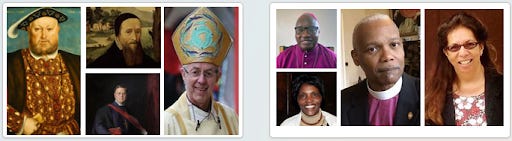
When we study church history, particularly Anglican history and theology, much attention is given to central events and figures in the Church of England, including Henry VIII, Thomas Cranmer, Richard Hooker, F. D. Maurice, John Henry Newman, William Temple, and Rowan Williams. While these people are important, we cannot overlook that Anglican Communion is polyphonic and much happened at the so-called margins. It was often at the margins that innovations and creativity occurred.
For example, the Rev. Florence Li Tim-Oi from the former British colony of Hong Kong was ordained as the first Anglican female priest in 1944 due to the exigencies of World War II. It was not till 1994, fully five decades later, that women were ordained in the Church of England. The Anglican Church in Aotearoa, New Zealand, and Polynesia sought to acknowledge the bicultural nature of the church and published A New Zealand Prayer Book in 1989. The beautiful Maori language and imagery speak to the interconnectedness of the cosmos. The Prayer Book provided a crucial example and template for postcolonial liturgy.
When we think about margins, we often contrast them with the center. However, without paying attention to the margins, we cannot fully understand the center. Postcolonial critics used to say that much of British history happened outside Britain. We need to see the center and the periphery as mutually inscribed.
Professor David Der-wei Wang of Harvard University said that there are two meanings to the term “border” in Chinese, which is equally applicable to “margin.” On the one hand, border can mean the boundary ( 邊界, 邊境 ). In this sense, the border is seen as secondary or peripheral to the center. On the other hand, the border can mean the space or place that brings two different entities or horizons together (邊際).1 The EDS Substack Margins seeks to provide a forum for bringing people together to share diverse ideas, hear resonances, intervene in public discourse, and stimulate creative social and political praxis.
When we speak prophetically and challenge the status quo, we encounter resistance and barriers. In my more than three decades living in the U.S., I have not encountered a time like ours when academic freedom is at stake and the fabric of democracy is fraying. International students and legal immigrants who spoke out for Palestinian rights have been arrested and threatened with deportation. The Trump administration wants to ban critical race theory and stop diversity, equity, and inclusion programs. Public libraries are asked to pull progressive books from their shelves. President Trump has intensified his attacks and pressure on universities, the media, the legal profession, immigrants, transgender people, and those who stand in his way.
At a time like ours, it is critical to have EDS’s prophetic voices speak, for we stand for anti-racism, justice, compassion, and reconciliation. We must conjure an alternative world in which freedom rings. Our teacher and colleague Canon Ed Rodman used to say, “Let us not be the instrument of our own oppression.”
We welcome your comments, feedback, and contributions to our Substack. We hope Margins will help strengthen connections within the wider EDS community and become a beacon of hope in this divisive world. EDS’s values continue to live in us wherever we are. We need to keep EDS’s prophetic flame burning bright.
Kwok Pui Lan is a Distinguished Scholar of the Episcopal Divinity School and the author of The Anglican Tradition from a Postcolonial Perspective. She is the host of the Kwok ‘n’ Roll podcast.
Professor David Der-wei presented a paper on “Borderland as Literature” at Harvard University on April 18, 2025.
Thank you and bless you! This is a huge gift to the church and the world. SIM will be sure to share this resource with all our Becoming Beloved Community scholars and alums. Very much looking forward to engaging in this conversation.
Wonderful—welcome to Substack!